I. Quelle est l’histoire des pièces de défi de l’Air Force ?
La Légende du “Insigne de vie et de mort”
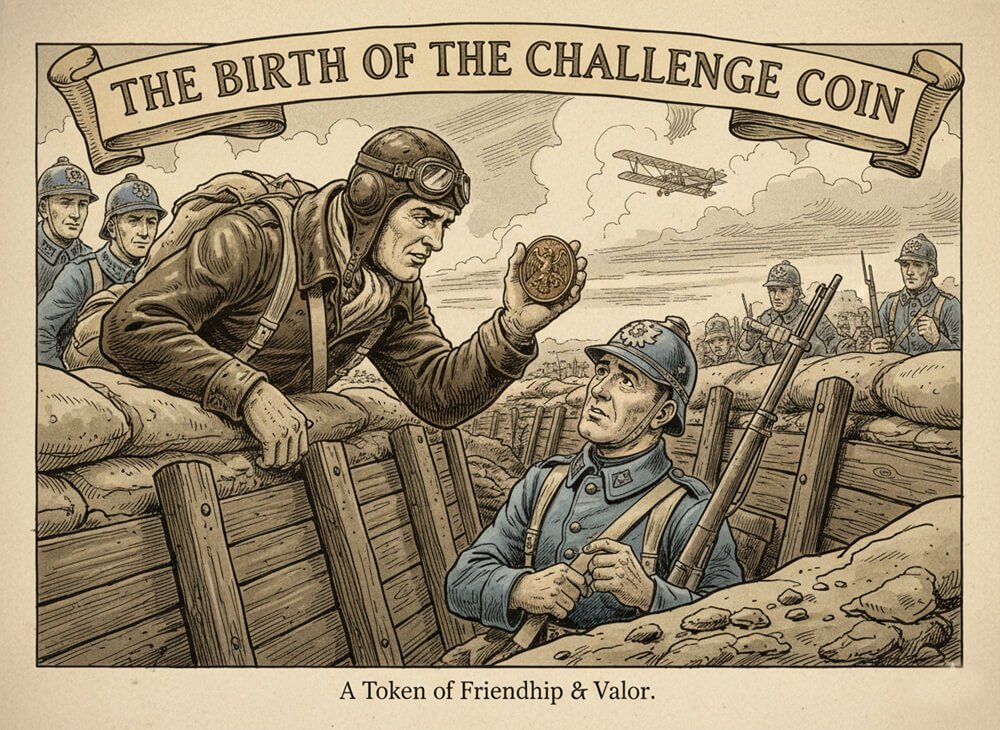
L’histoire d’origine la plus célèbre implique un riche lieutenant américain qui s’est porté volontaire pour rejoindre les escadrons volants nouvellement formés avant que les États-Unis n’entrent pleinement en guerre. Cet officier, voulant donner à son unité un symbole d’unité, commanda à chaque pilote des médaillons en bronze massif frappés de l’emblème de l’escadron. Un jeune pilote a placé ce médaillon dans une petite pochette en cuir portée autour du cou pour le garder en sécurité.
La catastrophe survint lorsque l’avion de ce pilote fut abattu derrière les lignes allemandes. Il a été capturé immédiatement. Au cours de son arrestation, les Allemands l'ont dépouillé de toutes ses pièces d'identité, mais ils ont oublié la petite pochette en cuir autour de son cou. Le pilote a finalement réussi une évasion audacieuse, naviguant à travers un no man’s land jusqu’à ce qu’il rencontre un avant-poste français. Cependant, les soldats français, se méfiant des saboteurs et des espions, ne le reconnaissent pas comme un allié. Sans pièce d’identité, il risquait d’être exécuté immédiatement.
Dans un dernier acte de désespoir, le pilote sortit le médaillon de bronze de sa pochette. L'un des ravisseurs français a reconnu l'insigne de l'escadron gravé sur la pièce. Ce petit morceau de métal a transformé son destin de peloton d'exécution en fête. Au lieu d'être exécuté, il reçut une bouteille de vin. Cet événement est souvent cité comme le tout premier “chèque de pièces de monnaie.”
Évolution après 1947
Bien que la tradition ait commencé avec l'Army Air Corps, elle s'est solidifiée en une culture distincte après que l'United States Air Force (USAF) est devenue une branche indépendante en 1947. À mesure que l'Air Force développait ses propres rituels distincts de l'armée, la pièce de défi est devenue un incontournable.
Au moment de la guerre de Corée, la pratique avait évolué. Les pièces de monnaie étaient utilisées non seulement pour survivre, mais aussi pour l'identification et la vérification des membres lors des réunions. Aujourd’hui, ils servent de pont entre l’héritage du passé et les missions de demain.
II. Quelle est la signification et le but de ces pièces ?
Un symbole d'identité et de transition
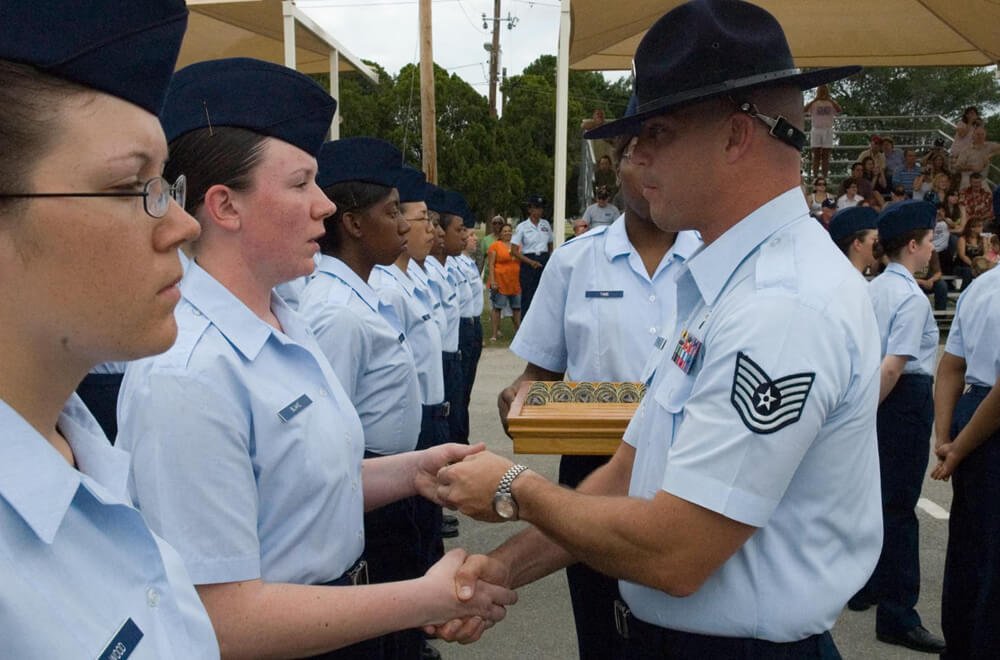
L’un des moments les plus marquants de la vie d’une nouvelle recrue se produit à la base aérienne de Lackland. Après avoir suivi les rigueurs de la formation militaire de base (BMT), les stagiaires ne reçoivent pas seulement un certificat. Au cours d'une cérémonie poignante, ils reçoivent le “Pièce d'aviateur.” Cet objet physique signifie la transition d'un stagiaire à un aviateur à part entière. Il s’agit souvent de la première pièce de monnaie de la collection d’un militaire et reste l’une des plus appréciées.
Représentation des valeurs fondamentales
Le design de ces pièces est rarement arbitraire. Ce sont des manifestations physiques des valeurs fondamentales de la Force aérienne. Vous retrouverez souvent ces valeurs intégrées dans la ferronnerie elle-même :
- L'intégrité d'abord : Souvent mis en valeur par des lettres en relief ou un placage or pour signifier la pureté et la vérité.
- Le service avant soi : Fréquemment gravé sur la tranche ou le revers de la pièce, servant de rappel constant de la mission collective plutôt que du gain personnel.
- Excellence dans tout ce que nous faisons : Représenté par l'exécution impeccable de la pièce elle-même : finitions polies, remplissages d'émail parfaits et construction en laiton massif.
Moral et Fraternité
Dans un escadron, une pièce personnalisée fait office de carte de membre d’une confrérie étroitement unie. Il favorise “esprit de corps.” Lorsqu’un commandant conçoit une pièce unique pour son unité, elle raconte l’histoire spécifique des déploiements, des avions et des blagues internes de ce groupe. Même dans le monde de l’entreprise, les entreprises ont adopté cette tradition militaire pour constituer des équipes qui opèrent en collaboration avec une unité militaire entraînée.
III. Comment le “Vérification des pièces” Un travail traditionnel ?
Les règles d'engagement
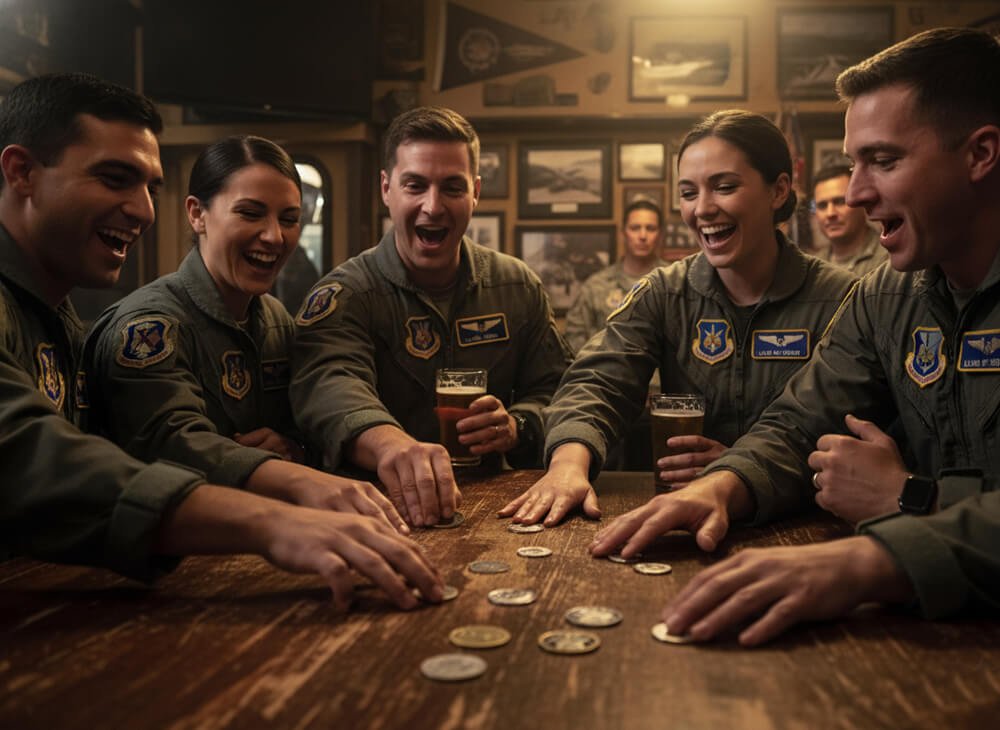
La tradition veut qu'un défi puisse être lancé à tout moment, généralement dans un bar ou une cantine. L'initiateur tire sa pièce et la tient en l'air ou la claque sur la table (bien que le claquement soit parfois déconseillé pour protéger la pièce). Voici comment se déroule le jeu :
| Action | Conséquence |
|---|---|
| Le défi | Un membre sort sa pièce et défie le groupe. |
| L'échec | Toute personne du groupe qui ne peut pas produire sa pièce immédiatement doit acheter une tournée de boissons (ou un repas) pour le challenger. |
| Le renversement | Si tout le monde Le challenger produit avec succès sa pièce, le challenger doit acheter la ronde pour tout le groupe. |
Cela crée une culture dans laquelle les aviateurs transportent leurs pièces partout – dans leur portefeuille, dans leur poche ou sur des chaînes – pour s'assurer qu'ils ne sont jamais pris au dépourvu.
La poignée de main secrète
Il existe également une étiquette spécifique pour attribuer une pièce de monnaie. Il est rarement remis librement. Au lieu de cela, la pièce est placée dans la paume de la main du commandant. Lors d’une vigoureuse poignée de main, la pièce est transférée secrètement dans la paume du destinataire. C'est un moment de respect partagé. Si vous êtes le destinataire, la tradition veut que vous preniez la pièce ; le refuser est considéré comme une insulte importante.
IV. À quoi ressemblent les pièces de défi de l'Air Force ? (Conception & Esthétique)
Éléments visuels communs
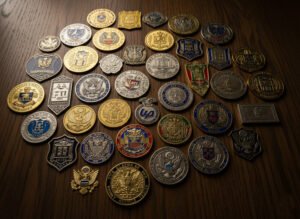
Les images sur ces pièces servent de résumé visuel de l'unité. Vous verrez fréquemment :
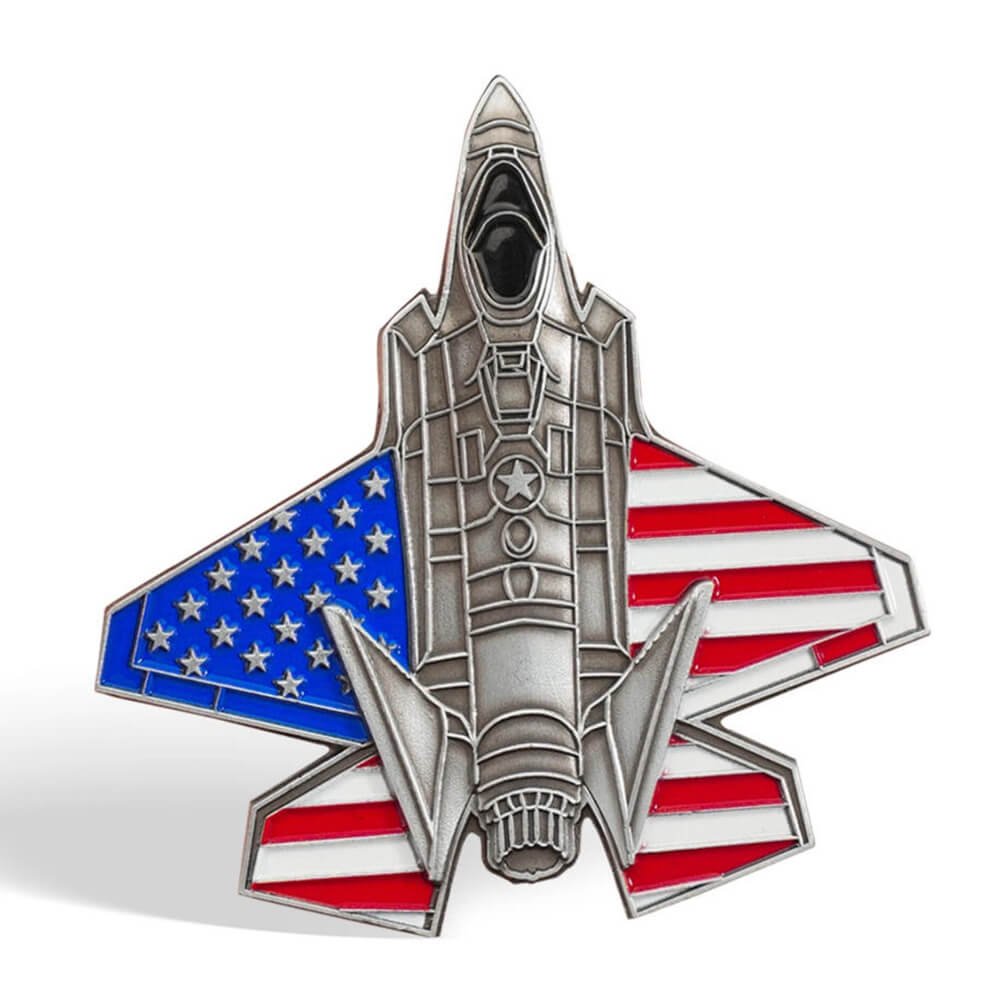
- Silhouettes d'avions : Les profils d'oiseaux légendaires comme le F-16 Fighting Falcon, le F-35 Lightning II, le bombardier B-2 Spirit ou le pétrolier KC-46 sont des éléments centraux. Ce ne sont pas que des dessins ; ils sont souvent modélisés en 3D pour montrer la texture du fuselage.
- Insigne d'unité : L'écusson de l'escadron est généralement la pièce maîtresse, rendu dans des couleurs d'émail vibrantes.
- Devises : Les bannières sur la pièce proclament des phrases telles que “Visez haut,” “Voler, combattre, gagner,” ou une unité spécifique crie comme “Alimenter le combat.”
Matériaux et finitions
Les pièces de monnaie standard sont frappées à partir de laiton lourd pour garantir qu'elles ont un poids satisfaisant : un “bruit sourd” lorsqu'on le laisse tomber sur une table. Les options de placage définissent le caractère de la pièce :
- Antique Bronze: Donne un look vintage usé au combat, parfait pour les unités patrimoniales.
- Or ou argent poli : Offre une finition luxueuse semblable à celle d'un bijou, souvent utilisée pour les récompenses.
- Nickel noir : Une finition moderne et tactique, élégante et avant-gardiste.
- Double placage : Une technique sophistiquée combinant l'or et l'argent sur la même pièce pour faire ressortir des logos spécifiques.
Fonctionnalités innovantes
Les concepteurs utilisent désormais le sablage sur le métal de fond. Cela crée une texture mate et granuleuse qui contraste magnifiquement avec les zones polies en relief, faisant scintiller l'emblème sous la lumière. Certaines unités intègrent même des matériaux uniques, tels que des coquillages écrasés ou des émaux translucides, pour créer des effets imitant le ciel ou les écrans radar. En outre, “découper” les pièces gagnent en popularité : ce sont des pièces qui brisent le moule circulaire, entièrement en forme d’avion de combat, de plaque d’identité ou de pointe de flèche.
V. Quels sont les différents types de pièces de monnaie de l'Armée de l'Air ?
1. Pièces d'unité de service actif
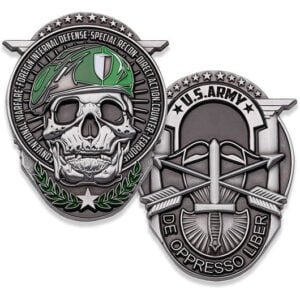
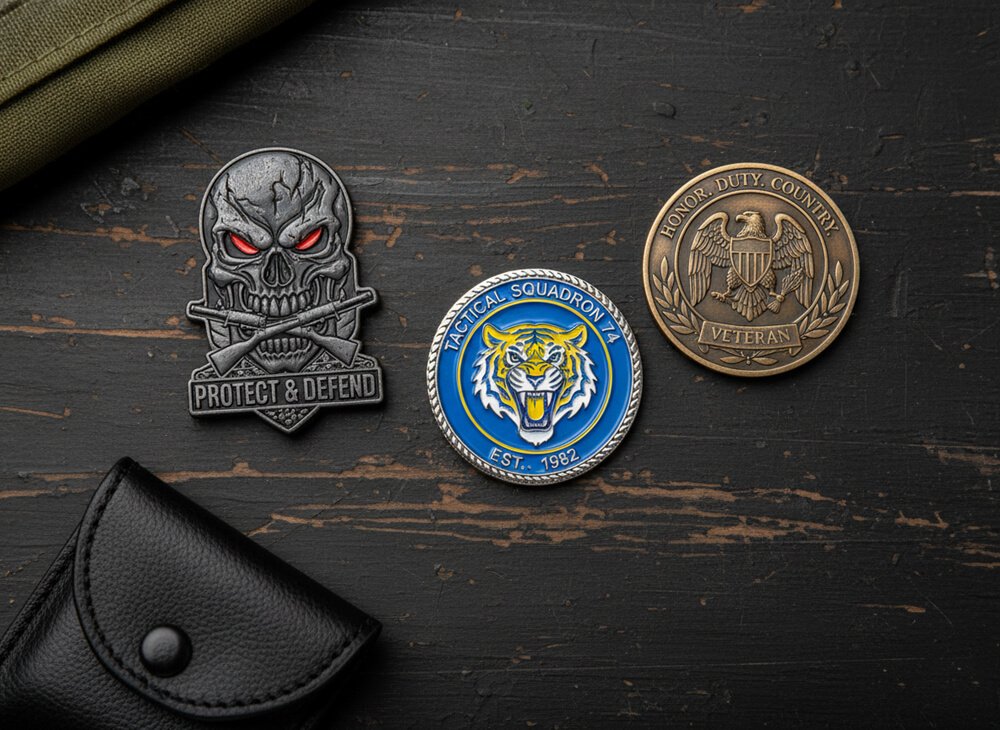
Ce sont les bêtes de somme de la tradition. Les exemples incluent des pièces pour le 50e Escadron comportant le F-16, ou des pièces du Global Strike Command qui intègrent des images de missiles balistiques intercontinentaux (ICBM). Les forces de sécurité ont souvent des designs distincts comportant des crânes, des bérets et des “Défenseurs de la Force” thématiques, projetant une image agressive et protectrice.
2. Pièces de remise des diplômes et de formation
Comme mentionné, le Pièce d'aviateur marque la fin du BMT. Pour les officiers, il y a le Pièce du premier salut, traditionnellement remis au premier militaire enrôlé qui rend hommage au nouvel officier. Les diplômés de l'Air Force Academy pourraient recevoir le Pièce de monnaie de la chapelle des cadets, commémorant l'architecture emblématique de leur alma mater.
3. Pièces de vétéran et de retraité
Ces pièces honorent une carrière de sacrifice. Ils comportent souvent le mot “À la retraite” bien en évidence, ainsi que les dates de service. Les conceptions se concentrent sur des valeurs telles que “Service, Loyauté, Devoir,” et peut commémorer des conflits spécifiques comme le Vietnam ou la tempête du désert.
4. Pièces de famille et de soutien
La famille militaire sert aussi. Pièces d'appréciation du conjoint honorez les partenaires qui entretiennent le feu de la maison lors de longs déploiements. Pièces de maman/papa fiers permettent aux parents d'afficher leur fierté, avec souvent des avions de combat et des gravures sincères.
5. Pièces spécialisées et de la Force spatiale
Avec la création de la Space Force, nous voyons de nouvelles conceptions comportant des trajectoires orbitales, des satellites et des graphiques du US Space Command. Les pièces historiques, comme celles honorant le SR-71 Blackbird, célèbrent l’histoire emblématique de l’aviation.
VI. Tendances de conception personnalisée 2025-2026 : ce que préfèrent les unités modernes
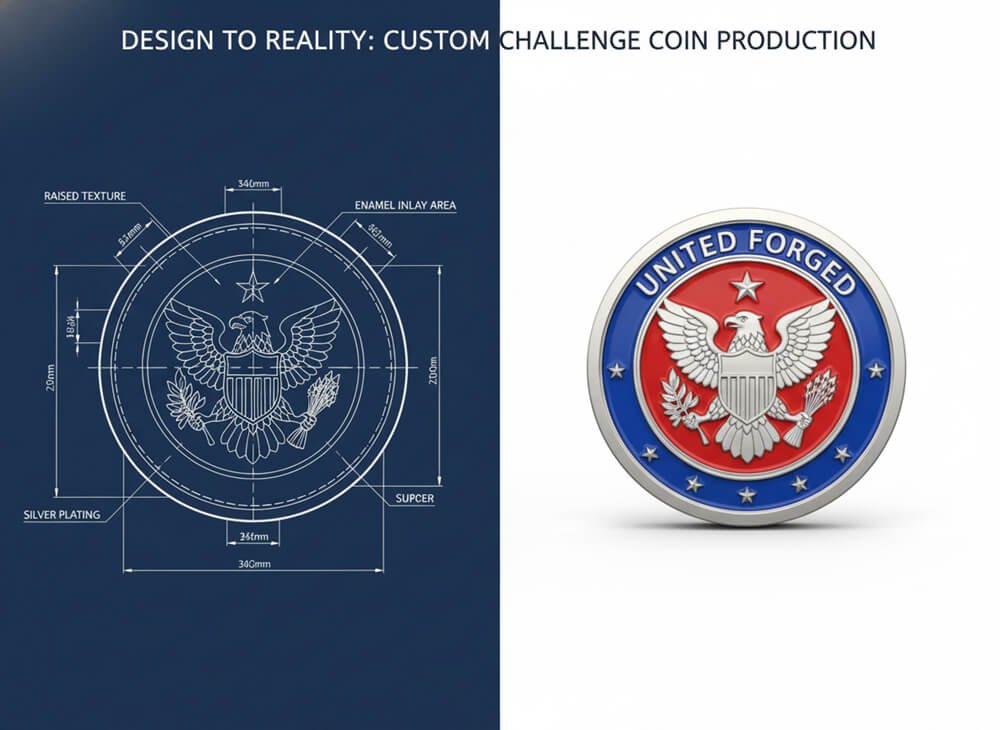
Si vous envisagez de commander des pièces pour votre unité au cours de l'année à venir, il est utile de savoir ce qui est actuellement demandé. Les unités s'éloignent des jetons génériques pour se tourner vers des pièces tactiles hautement personnalisées.
Sur la base de données de fabrication récentes, voici un aperçu des caractéristiques dominant le marché :
| Caractéristique de conception | Popularité | Pourquoi c'est tendance |
|---|---|---|
| Relief multicouche 3D | 60% des commandes | Les emblèmes en relief confèrent à la pièce de la profondeur et une sensation de sculpture haut de gamme. |
| Émail polychrome | Forte demande | L'émail doux ou dur est essentiel pour donner aux patchs et aux drapeaux un aspect vif et précis. |
| Conception double face | 55% des commandes | L'utilisation des deux faces permet plus de narration : logos sur le devant, devises/dates au dos. |
| Formes personnalisées | 25% des commandes | S'éloigner des cercles pour adopter des formes comme des silhouettes d'avions ou des boucliers rend la pièce unique. |
| Gravure des bords | 30% des commandes | Utilisé pour la numérotation séquentielle (éditions limitées) ou le texte comme “Prêt pour le contrôle des pièces.” |
VII. Comment commander des pièces de défi personnalisées de l'Armée de l'Air
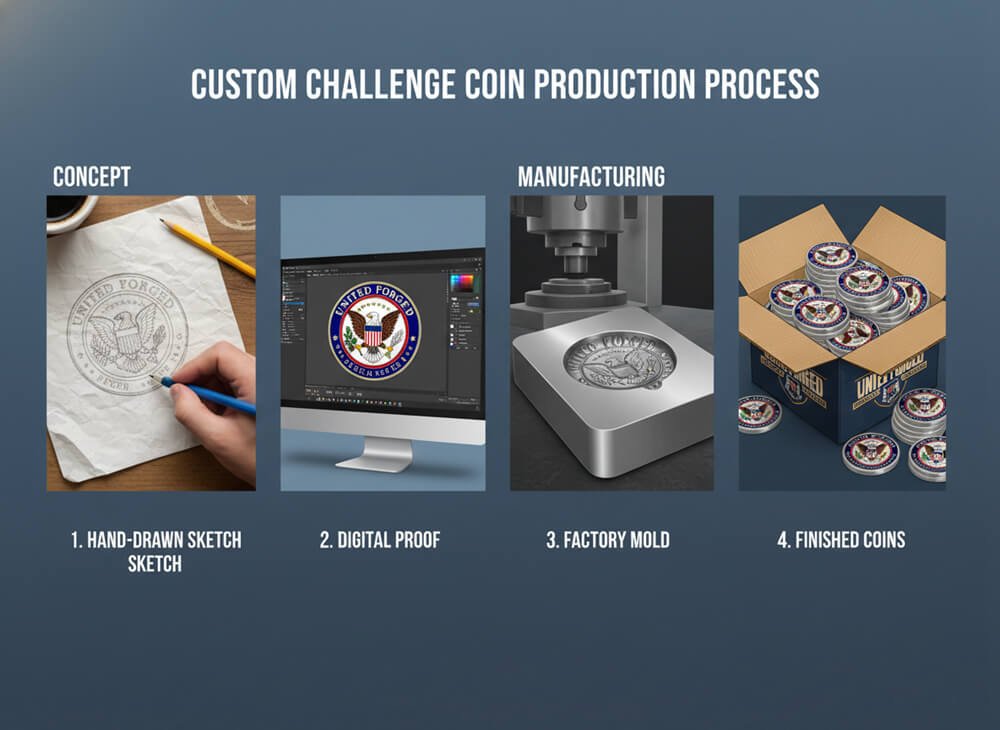
Commander des pièces personnalisées était autrefois un casse-tête impliquant des télécopieurs et de vagues promesses. Aujourd’hui, le processus est rationalisé et transparent. Si vous suivez ce flux de travail simple, vous pouvez passer d'une idée vague à un héritage tangible en moins d'un mois.
Étape 1 : Partagez votre idée
Vous n'avez pas besoin d'être graphiste. La plupart des fabricants professionnels acceptent n'importe quoi, depuis un fichier Photoshop soigné jusqu'à un croquis sur une serviette. Vous pouvez même simplement télécharger une photo du patch de votre unité. La clé est de transmettre le concept.
Étape 2 : Recevez une maquette numérique
Une fois votre idée soumise, l’équipe de conception se met au travail. Dans les 24 à 48 heures, vous devriez recevoir un BAT numérique. Il s’agit d’une étape critique. Recherchez un fournisseur qui propose révisions illimitées. Vous souhaitez modifier les couleurs, ajuster la taille de la police et perfectionner la mise en page jusqu'à ce qu'elle corresponde exactement à votre vision.
Étape 3 : Confirmer les spécifications
C'est ici que vous finalisez les traits physiques.
* Taille: Les pièces standard ont un diamètre de 1,5 à 2 pouces.
* Épaisseur: Une épaisseur de 3 mm à 4 mm assure un poids de qualité.
* Type d'émail : Choisir Émail doux pour une sensation texturée en 3D où vous pouvez sentir les crêtes métalliques, ou Émail dur pour une finition lisse de qualité bijou. Impression UV est une option pour les conceptions nécessitant des dégradés complexes.
Étape 4 : Production et livraison
Une fois approuvées, les matrices sont découpées et la production commence. Selon la complexité (comme les moules 3D ou le double placage), la production prend généralement de 7 à 30 jours. Les pièces sont soumises à un contrôle de qualité avant d'être expédiées. Lorsque vous choisissez un fabricant, recherchez ceux qui sont “adapté aux petits lots,” offrant des quantités minimales de commande (MOQ) aussi basses que 50 pièces. C’est parfait pour les vols ou les détachements qui n’ont pas besoin de centaines de pièces.
VIII. Collectionner des pièces de monnaie de l'armée de l'air : valeur et marché
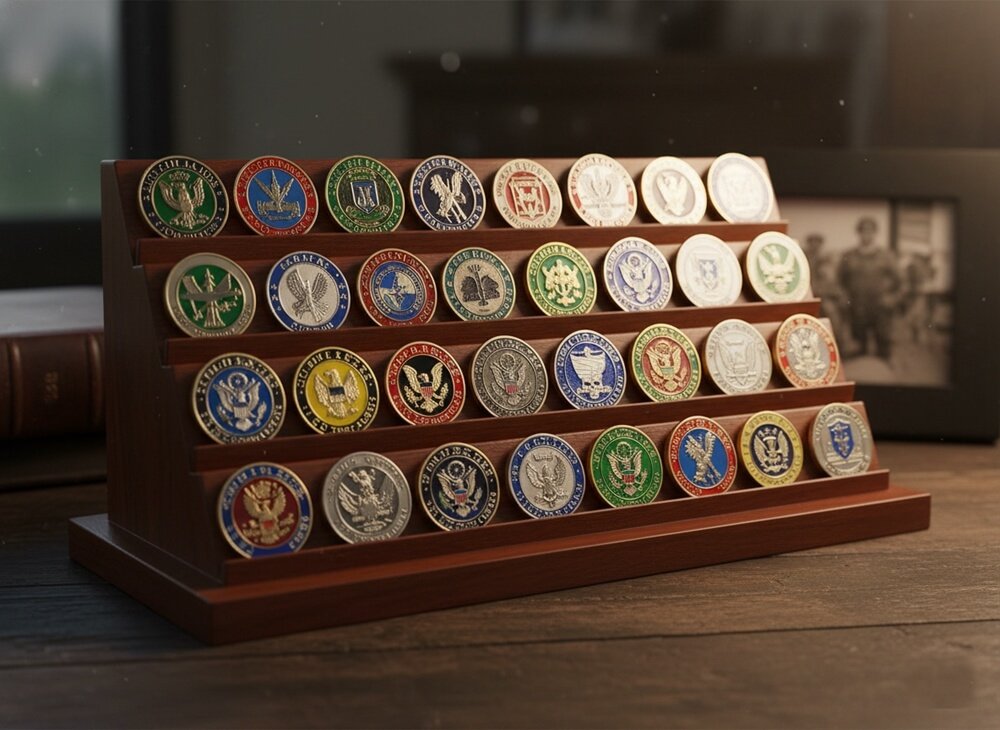
Bien que de nombreuses pièces soient gagnées, il existe un marché solide pour les collectionneurs souhaitant préserver l’histoire militaire. La valeur d’une pièce est déterminée par sa rareté, sa signification historique et son état.
Analyse de marché
Si vous cherchez à acheter ou à vendre, voici un guide général des valeurs marchandes actuelles :
| Type de pièce | Prix du marché (USD) | Niveau de rareté |
|---|---|---|
| Pièces standard en stock | 15 $ – 30 $ | Faible |
| Éditions d'unités personnalisées | 40 $ – 80 $ | Moyen (souvent réservé aux membres de l'unité) |
| Commémoratives limitées | 100 $ – 300 $ | High (Éditions numérotées, exclusivités musées) |
| Éditions collector premium | 300 $+ | Très Haut (Pièces historiques rares) |
Lors de la collecte, vérifiez toujours l’authenticité. Vérifiez la gravure précise et les logos officiels. Le marché secondaire, comme eBay ou les forums de collectionneurs, peut être une mine d'or, mais méfiez-vous des contrefaçons bon marché. Les magasins officiels du musée de l'USAF et les fabricants certifiés constituent le pari le plus sûr pour de nouvelles acquisitions.
IX. Applications commerciales et d'équipe
L’utilité de ces pièces s’étend bien au-delà de la ligne de vol. Le monde de l’entreprise a pris conscience du puissant impact psychologique de la pièce de défi.
- Image de marque de l'entreprise : Les compagnies aériennes utilisent souvent des pièces personnalisées comme cartes de visite haut de gamme. Contrairement à une carte en papier qui est jetée, une pièce de monnaie en métal lourd avec un logo reste conservée sur un bureau pendant des années.
- Reconnaissance des employés : Les entreprises créent “Carte Or” pièces de statut pour les plus performants. Cela imite le sentiment militaire d’appartenance à une élite.
- Collecte de fonds : Les pièces en édition limitée sont d’excellents outils de collecte de fonds. Les organisations peuvent frapper une série spécifique de pièces et reverser les bénéfices aux anciens combattants.’ fonds ou musées, tirant parti de la nature de collection de l’objet pour générer des dons.
X. Questions fréquemment posées
Ai-je besoin d’un design professionnel final pour commander des pièces personnalisées ?
Non. La plupart des fabricants acceptent les croquis, les captures d’écran de logos ou même les descriptions verbales. Leurs départements artistiques convertiront vos idées en une épreuve numérique professionnelle que vous pourrez approuver.
Quelle est la quantité minimum de commande (MOQ) typique ?
Bien que les commandes groupées soient courantes, de nombreux fabricants axés sur le client proposent un MOQ de seulement 50 pièces. C’est idéal pour les petites unités, les vols ou les événements spéciaux.
Combien de temps faut-il pour recevoir mes pièces ?
Les délais de production varient en fonction de la complexité. Les commandes standard prennent généralement 1 à 4 semaines à compter du moment où vous approuvez l'œuvre d'art. Des options urgentes sont souvent disponibles pour des délais serrés.
Quelle est la différence entre l’émail doux et l’émail dur ?
Les pièces en émail doux ont une surface texturée où les crêtes métalliques sont surélevées et la peinture est en retrait, ce qui lui donne une sensation 3D. Les pièces en émail dur sont polies à plat, de sorte que la peinture et le métal affleurent, créant une finition lisse semblable à celle d'un bijou.
Les civils peuvent-ils acheter ou collecter des pièces de défi de l'Air Force ?
Absolument. Si certaines pièces unitaires sont exclusives aux membres, de nombreuses pièces commémoratives et de supporters sont accessibles au public. Les collectionner est une excellente façon d’honorer l’histoire militaire et de soutenir les forces armées.
XI. Conclusion
D'un insigne de sauvetage dans les tranchées de la Première Guerre mondiale à un symbole moderne d'excellence porté par les pilotes du F-35 Lightning II, la pièce de défi de l'US Air Force a parcouru un chemin remarquable. C'est plus qu'un simple morceau de laiton ou de zinc ; c'est un souvenir tangible du service, un gage de fraternité et un rappel important des valeurs fondamentales qui guident la force.
Que vous soyez un commandant cherchant à remonter le moral, un ancien combattant souhaitant commémorer son service ou un membre de la famille honorant un être cher, une pièce personnalisée a un poids émotionnel que peu d'autres cadeaux peuvent égaler. Il capture un héritage métal qui durera pendant des générations.