
The Fundamental Question: Can Anyone Wear an American Flag Lapel Pin?

Let’s address the most common query right off the bat: Yes, absolutely, anyone can wear an American flag lapel pin. There are no legal restrictions preventing any private citizen from displaying this symbol of national pride. Whether you’re 18 or 80, male or female, or come from any background, the pin is accessible to all who wish to wear it.
However, the simplicity of this answer comes with an important nuance: it must always be worn with respect and a clear understanding of its significance. The flag lapel pin is not just another accessory; it is a miniature representation of the United States flag itself, and thus, it carries profound cultural and emotional weight.
Addressing Misconceptions
Some people mistakenly believe that only veterans, active military personnel, or government officials have the right to wear an American flag lapel pin. This is a common misconception. While these groups frequently wear the pin, and for very specific reasons, the U.S. Flag Code does not restrict its wear to any particular demographic. Instead, the Flag Code focuses on the etiquette of display, emphasizing that the flag’s symbolism must always be upheld. Wearing the pin is a personal way for everyday citizens to express their appreciation for the country, its values, and its history. It is a universal representation of love and respect for the United States.
Who Traditionally Wears the American Flag Lapel Pin?

While the right to wear a flag lapel pin extends to all, certain individuals and groups traditionally don this emblem as part of their identity or role. Their reasons for doing so offer a glimpse into the diverse ways this small symbol communicates big ideas.
Private Citizens: Everyday Patriotism
For ordinary Americans, wearing a flag lapel pin is a personal declaration of love for their country and support for its values and institutions. It’s a simple, yet powerful, form of self-expression. Civilians commonly wear these pins:
- During National Holidays: Celebrations like Independence Day, Memorial Day, Veterans Day, and Flag Day are prime occasions for public displays of patriotism.
- In Times of Tragedy or National Crisis: A flag pin can show solidarity and respect for victims of natural disasters or terrorist attacks, symbolizing unity and resilience in the face of adversity.
- To Support Troops: It’s a quiet nod of appreciation for the sacrifices made by service members and their families.
Government Officials & Politicians: A Symbol of Duty
Perhaps the most visible wearers of the flag lapel pin are politicians and government officials. For them, it’s more than just an accessory; it signifies their loyalty and unwavering service to the country. This practice has become so ingrained that the absence of a flag pin can sometimes spark controversy, as seen with former President Barack Obama early in his political career.
Wearing the pin is a visual way to broadcast loyalty and patriotism without uttering a single word, reinforcing their commitment to national values during public appearances, speeches, and international events.
Military Personnel & Veterans: Honoring Service and Sacrifice
For those who have served or are currently serving in the U.S. Armed Forces, the flag lapel pin is deeply personal. It symbolizes dedication, sacrifice, and the profound connection to their country and fellow service members. Military personnel often wear these pins as part of their formal uniforms, adhering to strict regulations. Veterans frequently wear them on civilian clothing to honor their past service and their commitment to the nation.
First Responders: Public Service and Unity
Police officers, firefighters, and paramedics often wear flag lapel pins as part of their uniforms or on civilian attire during official events. For them, it represents their unwavering commitment to public service, their dedication to protecting and serving their communities, and the unity within their departments. It’s a way to signify their allegiance and their shared responsibility to uphold the values of the country.
Patriotic Organizations: Affiliation and Shared Values
Members of groups like the American Legion, Veterans of Foreign Wars (VFW), or the Daughters and Sons of the American Revolution frequently wear flag pins. For them, it’s a clear symbol of their affiliation, their shared values, and their active participation in preserving the nation’s heritage and supporting its causes.
Business Professionals: Diplomacy and National Pride
In corporate settings, particularly during international events, conferences, or meetings, business professionals may wear flag lapel pins. This signifies national pride and can serve as a subtle diplomatic courtesy, especially when representing their company or country on a global stage. It adds a touch of professionalism and signals their national identity.
Historical Journey of the American Flag Lapel Pin

While the American flag itself has a long and storied history, the widespread adoption of the flag lapel pin is a relatively modern phenomenon. It hasn’t been around as long as the flag itself, or even as long as general lapel pins.
Early Flag Use: From Military to Civilians
The reverence many Americans feel for the Stars and Stripes wasn’t always present. According to historians, before the Civil War, very few private citizens actually owned or flew the flag. Its display was largely limited to military and federal facilities. It was only when the Confederacy began winning battles early in the Civil War that Northerners began flying the flag as a visible sign of pride in the Union. This marked a pivotal shift, transforming the flag into a symbol of national patriotism for ordinary citizens.
Post-World War II Emergence (1950s)
Surprisingly, even during World War II, flag lapel pins were not a common sight. Graphic designers and memorabilia collectors note that flag lapel pins, as we recognize them today, didn’t really start to emerge until the 1950s. Before then, you might find flag jewelry like cufflinks or brooches, but not the small lapel pin that is now ubiquitous. This period following WWII saw a rise in Americans wanting a tangible way to express their pride and unity in the post-war era.
The Nixon Era (1970s): A Political Statement
The flag lapel pin truly took off and became a national phenomenon during the presidency of Richard Nixon in the early 1970s. The inspiration came from an unlikely source: Nixon’s chief of staff, H.R. Haldeman, noticed Robert Redford’s character wearing one in the 1972 film “The Candidate.” Nixon liked the idea and commanded his entire White House staff to start wearing them. This was during the Vietnam War, and the flag pin became a powerful symbol of patriotic solidarity against anti-war protestors.
However, this era also saw controversy. Anti-war demonstrators, in protest, sometimes wore the flag pin upside down as a symbol of distress, a practice that continues to carry a specific meaning today.
The 9/11 Resurgence (2001)
After Nixon’s second term, the flag lapel pin’s popularity waned for nearly 30 years. It wasn’t until the tragic events of September 11, 2001, that the pin experienced a massive resurgence. President George W. Bush, who was not initially wearing a flag pin on the morning of the attacks, donned one before addressing the nation. From that day forward, the flag lapel pin became a mainstay on the lapels of politicians and a widespread symbol of national unity and solidarity in the face of crisis. The country was shaken, and the pin became a simple, immediate way to show collective resolve.
Modern Political Symbolism and Controversy
Today, the presence—or absence—of a flag pin on a politician’s lapel is often highly scrutinized. Former President Barack Obama faced questions about his patriotism for not wearing one early in his career, prompting him to eventually adopt the practice. Even seemingly innocuous designs can stir controversy, as seen when former Governor Chris Christie’s New Jersey-shaped pin almost led to a lawsuit over its copyright. The flag pin has become a “shibboleth” in political culture, a quick visual cue that can signal a politician’s stance on national issues.
Decoding the U.S. Flag Code: Etiquette for Wearing Your Pin
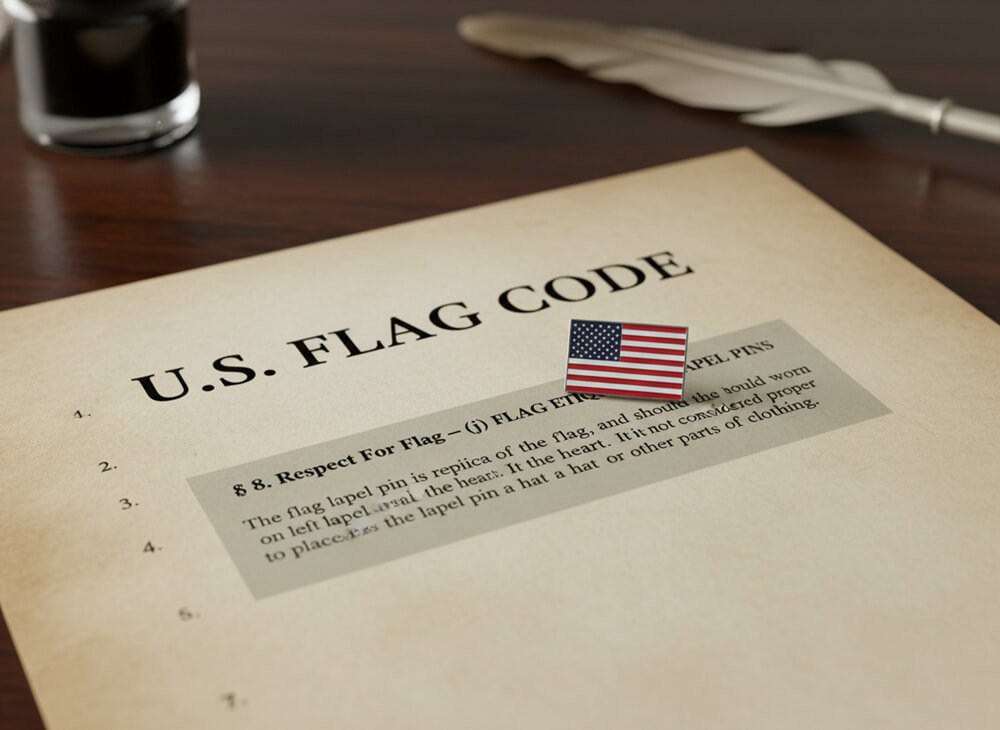
The American flag lapel pin is not merely a decorative item; it is a replica of the national flag, and as such, it falls under the guidelines of the U.S. Flag Code (Title 4, United States Code, Chapter 1). This code is the ultimate authority on how the flag, and its representations, should be treated. While largely a set of guidelines rather than enforceable law for civilians, adhering to it demonstrates profound respect.
Core Principle: The Flag as a “Living Thing”
The foundational principle of the Flag Code is simple: “The flag represents a living country and is itself considered a living thing.” This core belief underpins all subsequent rules. Therefore, a flag lapel pin, being a replica, must be treated with the same reverence and dignity as a full-sized flag.
Placement Rules: Where to Pin It
The Flag Code is very clear about where a flag lapel pin should be worn:
- Left Lapel, Near the Heart: This is the primary and most important rule. Section 8(j) states that the lapel flag pin “should be worn on the left lapel near the heart.” This placement symbolizes your loyalty, patriotism, and love for your country.
- On a Tie (No Blazer): If you are a man wearing a tie but no suit jacket or blazer, the preferred placement for the pin is in the center of the tie. It should be worn on its own, not in conjunction with another tie tack or clip, ensuring it remains the sole patriotic focus.
- On a Shirt (No Jacket or Tie): For individuals wearing neither a jacket nor a tie, the flag pin should be placed on the left side of their shirt, just above their heart. This maintains the symbolic proximity to the heart, regardless of the garment.
Orientation Rules: Displaying it Correctly
How the flag pin faces is just as important as where it is placed:
- Upright and Forward: The pin must always be displayed in an upright position. This means the blue field of stars should always be in the upper left corner of the pin (when viewed by the wearer on their left lapel). It should appear to be “flying” forward if it were on a flag pole.
- Never Upside Down: Displaying the flag upside down is strictly prohibited, except in one rare circumstance: as a “signal of dire distress in instances of extreme danger to life or property.” Accidentally wearing it inverted can be misinterpreted as opposition to the U.S. or as a call for help.
- No Sideways or Backward Display: The pin should never be worn sideways or backward. Its orientation should always convey forward motion and respect.
- Securely Attached: Ensure the pin is firmly attached to your clothing so it doesn’t spin around. A rotating or dangling pin is not only distracting but risks being displayed incorrectly.
Size Guidelines: Modesty and Reverence
While the Flag Code does not specify an exact size, it emphasizes that the flag should be displayed with “reverence.” This translates to choosing a pin that is understated and respectful, rather than “garish” o “attention-seeking.”
- Recommended Size: Most sources suggest opting for smaller designs, typically between half an inch to 1.25 inches in diameter. This size is noticeable but maintains a classy and professional look, especially in business settings.
- Avoid Oversized Pins: Pins that are excessively large can detract from the flag’s dignity and may appear more like a novelty item than a symbol of respect.
Avoid Covering the Flag
The Flag Code implicitly (and explicitly in some interpretations) suggests that the flag should occupy a place of honor. Therefore:
- The flag pin should ideally not be placed below other pins.
- It should never be covered by other accessories.
- It should be the “highest placed piece” if other pins are worn on the same lapel, though generally, wearing only one pin is recommended for the flag.
Altering the Flag is Illegal
This is a particularly strong prohibition in the Flag Code, found in Section 8(g): “The flag should never have placed upon it, nor on any part of it, nor attached to it any mark, insignia, letter, word, figure, design, picture, or drawing of any nature.”
This means:
- You cannot add text, logos, or other images directly onto the flag’s design.
- You cannot change the number of stars or stripes, even for artistic reasons.
- The punishment for knowingly altering the image of the U.S. flag can be up to a $100 fine or thirty days in jail.
This strict rule guides custom pin manufacturers to ensure their American flag pins adhere to the accurate representation of the flag. While “friendship flags” that cross two national flags are common, they are distinct from altering a single flag image.
When and Where to Display Your American Flag Lapel Pin

The American flag lapel pin is a versatile symbol, appropriate for a wide range of occasions. Knowing when and where to wear it ensures your gesture is meaningful and appreciated, rather than out of place.
Appropriate Occasions for Wearing a Flag Pin
These are the moments when donning a flag pin truly resonates:
- National Holidays: These are the most obvious and universally accepted times. Think Independence Day (July 4th), Memorial Day, Veterans Day, Flag Day (June 14th), and even Pearl Harbor Day (December 7th). These days are dedicated to remembrance, celebration, and national pride.
- Formal Events and Ceremonies: Banquets, official gatherings, civic events, and formal presentations are ideal. The pin complements formal attire while conveying respect and patriotism, particularly for those in public service or leadership roles.
- Workplace Settings: Depending on your profession, a flag pin in the office can be a subtle yet meaningful way to showcase pride. It’s especially appropriate for those in public service, education, or roles that involve representing national interests.
- Times of Tragedy or National Crisis: A flag pin can show solidarity, unity, and resilience. Following events like 9/11, flag pins became ubiquitous as a way to express collective resolve and support for the nation.
- Honoring Individuals: Wearing a flag pin in memory of a veteran, a fallen first responder, or a family member who served is a deeply personal and heartfelt gesture of respect and remembrance.
- Political Rallies and Campaigns: As discussed, flag pins are a mainstay in political arenas, used by candidates and their supporters to visually align with national pride and core values.
Where to Avoid Wearing It
Just as there are appropriate times, there are also situations where wearing a flag pin might be considered inappropriate or diminish its symbolic value:
- Informal or Inappropriate Settings: While personal style allows for some flexibility, wearing a flag pin in extremely casual or irreverent settings might dilute its meaning or appear out of place. The key is to project genuine patriotism, which can sometimes allow for more casual wear during sports events, but discretion is advised.
- Strenuous Activities: During intense sports or outdoor activities, the pin could get damaged, lost, or even cause injury. This disrespects the symbol.
- On Costumes or Athletic Uniforms: The Flag Code generally prohibits using the flag as a costume or athletic uniform. While this is sometimes overlooked in practice (e.g., in Hollywood movies or by athletes at press conferences), the intent of the wearer matters most. However, the Flag Code does make an exception for flag patches affixed to the uniforms of military personnel, firemen, policemen, and members of patriotic organizations.
- Funerals: While a flag pin can be a respectful addition to a funeral for someone who served, overly flashy or garish pins should be avoided. The overall tone should be somber and respectful, not attention-seeking.
Proper Positioning and Attachment on Various Attire
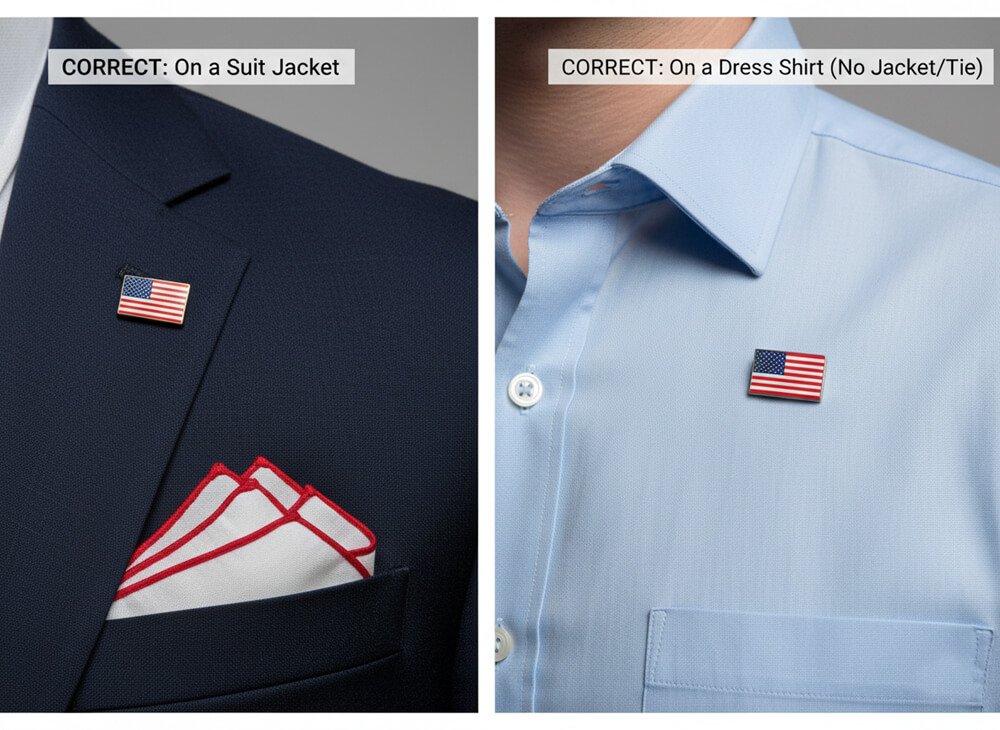
Ensuring your American flag lapel pin is properly positioned and securely attached is crucial for maintaining a polished look and showing due respect. Different garments call for slightly different approaches.
On Suits & Blazers
This is the classic placement. Your pin should be on the solapa izquierda.
- Using the Buttonhole: If your suit jacket or blazer has a buttonhole on the left lapel, this is the ideal spot. You should glide the pin stem through the front of this slit. Then, on the backside of the lapel, angle the pin slightly downwards so the flag sits straight on the front. Secure it firmly with its backing clasp.
- If No Buttonhole: Not all jackets have a pre-made buttonhole. In this instance, carefully pierce the fabric of the lapel where the buttonhole would typically be located. The sharp post of a quality lapel pin is designed to go through fabric without causing noticeable damage, especially in heavier materials like wool.
- Alignment: The pin should sit flat against the lapel, following its natural curve. It should be positioned roughly 1-2 inches below the top of the collar, close to the lapel seam. If you’re wearing a pocket square, the pin should be placed above the top of the pocket square to avoid obscuring either accessory.
On Ties
If you’re wearing a tie but no suit jacket or blazer, the tie can serve as the canvas for your flag pin.
- Colocación: Position the flag lapel pin in the center of the tie, ideally around the upper third (roughly where your breast pocket would be on a jacket). This ensures it’s prominently displayed.
- Avoid Tie Tacks: If you choose to wear a flag pin on your tie, it should be the sole accessory on the tie. Do not wear it in conjunction with a tie tack or clip, as this creates a cluttered and distracting look.
On Shirts (No Jacket/Tie)
For more casual settings where you’re only wearing a shirt, the flag pin can still be worn to express patriotism.
- Colocación: The pin should be worn on the left side of your shirt, just above your heart. Imagine where a breast pocket would be and place it there.
- Collar Option: For smaller pins, some individuals choose to place them subtly on the shirt collar itself, though this is a less traditional and more modern stylistic choice.
On Uniforms (Military, Police, Firefighters)
For uniformed personnel, the Flag Code explicitly states that military personnel, policemen, firemen, and members of patriotic organizations are permitted to wear flag lapel pins as part of a formal uniform.
- Standard Placement: As with civilian attire, the pin should appear on the left lapel or above the heart.
- Branch-Specific Regulations: It is crucial to always refer to the prevailing dress standards and specific regulations of the individual military branch or department. For instance, Army Regulation 670-1 specifies that a flag patch on the right sleeve must have the blue union (stars) facing forward, to appear as if the flag is blowing back in the wind as the wearer moves forward—never retreating.
On Hats
Flag pins can also adorn hats, adding a patriotic touch to headwear.
- Colocación: For baseball caps and other less formal hats, pins can be placed almost anywhere, though typically to the side or front. For more formal hats like fedoras or cowboy hats, placement along the band or in the “pinch” of the hat is common.
- Security: Ensure the pin is securely fastened to prevent loss, especially on active-wear hats.
Backing Mechanisms: Ensuring Security
The type of backing on your pin affects its security and ease of use:
- Butterfly Clutch (Standard): This is the most common backing, easy to attach and remove. Ensure the two small prongs are fully pressed together for a secure fit.
- Screw-Back: Offers a very secure attachment, ideal for heavier or more valuable pins. It involves screwing a small nut onto the pin post.
- Respaldo magnético: Perfect for delicate fabrics or expensive garments where you want to avoid puncturing the material. A strong magnet holds the pin in place from behind the fabric.
- Safety Pin Back: Often found on larger badges or temporary pins, providing a broad and secure hold.
Ethical Considerations and Common Mistakes to Avoid
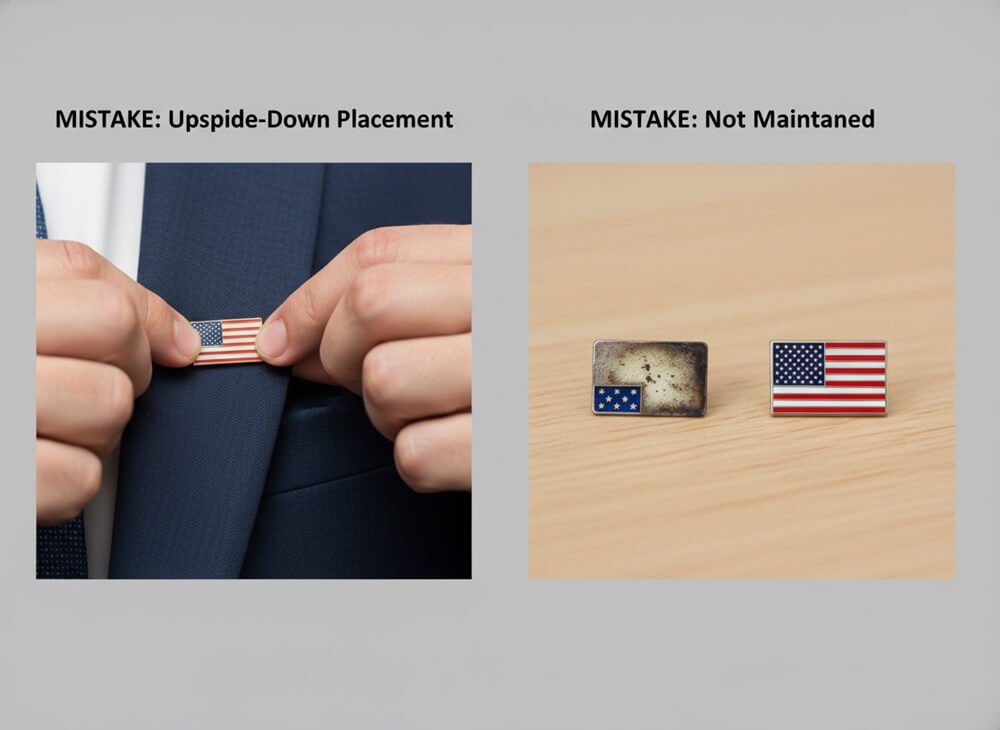
Wearing an American flag lapel pin is a privilege that comes with the responsibility of upholding the dignity of the flag. Careless display can lead to misinterpretation or, worse, disrespect. Here are key ethical considerations and common mistakes to steer clear of.
1. Respect for the Flag: Never Desecrate
The cardinal rule of the Flag Code is “No disrespect should be shown to the flag.” This extends to its replica. Any action that demeans or defiles the flag pin is considered a violation of this principle. This includes:
- Never allowing it to touch anything beneath it: Just as a full-sized flag should not touch the ground, your pin should be secured so it doesn’t brush against surfaces or clothing below it.
- Not using it as a receptacle: The flag should never be used to hold, carry, or deliver anything. Your pin is not a makeshift clip.
2. Avoid Incorrect Orientation: The Distress Signal
As previously mentioned, wearing the flag pin upside down is a serious breach of etiquette. It is internationally recognized as a signal of dire distress, implying “extreme danger to life or property.” Accidentally wearing it this way can cause alarm or be misconstrued as opposition to the U.S. Always double-check its upright position.
3. The Peril of Alterations: Legal Ramifications
The Flag Code is unequivocally clear: “No part of the flag should ever be… attached to it any mark, insignia, letter, word, figure, design, picture, or drawing of any nature.” This is a critical point for anyone considering customizing flag pins:
- You cannot overlay your company logo, a political slogan, or any other image directly onto the Stars and Stripes.
- Changing the number of stars or stripes is also prohibited.
- Violating this code can lead to legal penalties, including fines and jail time.
This is why designs combining two flags (like a U.S. flag with a Canadian flag, often called “friendship flags”) are created as distinct, separate entities on one pin, rather than one flag altered by another symbol.
4. Overuse and Dilution of Meaning
While wearing a flag pin is patriotic, its constant, indiscriminate use, especially in informal settings, can dilute its profound meaning. Some argue that wearing it every day, regardless of context, can reduce it to merely a “fashion statement” rather than a sacred symbol. Politicians often face this criticism, as their constant display can be seen as less genuine patriotism and more political signaling.
5. Pin Clustering or Over-Accessorizing
For a clean, respectful look, less is often more. Wearing too many pins, especially if they are large or flashy, can clutter your lapel and distract from the flag’s significance. If you must wear multiple pins, ensure they are spaced appropriately and that the flag pin holds the highest position of honor without being obscured.
6. Quality and Condition Matters
A tarnished, faded, or damaged flag pin reflects poorly on the wearer and disrespects the symbol. It is important to keep your pin clean and in good condition. If a pin starts to tarnish significantly or gets worn down, it should be “retired” respectfully, much like an unserviceable full-sized flag, which is preferably destroyed in a dignified way, such as by burning.
Flag Pins and Other Countries
While the U.S. Flag Code provides specific rules for the American flag, it’s important to remember that these regulations primarily apply within the United States and its territories. However, the spirit of respect for national symbols is universal.
1. Other Nations’ Flag Codes
Just as the U.S. has its Flag Code, many other countries have their own laws and customs governing the display and treatment of their national flags. If you plan to wear or produce flag pins depicting other nations (or even U.S. state/provincial flags), it is essential to research and adhere to their specific guidelines. For example, some countries may have different rules regarding orientation, size, or appropriate occasions for display.
2. Friendship Flags and Diplomacy
A popular type of pin, especially in international business and diplomatic circles, is the “friendship flag” pin. These pins often feature two or more national flags crossed or side-by-side on a single emblem. They symbolize:
- International Cooperation: Representing trade agreements, joint ventures, or diplomatic pacts between nations.
- Cultural Exchange: Often worn by individuals traveling abroad to signify their origin and openness to other cultures.
- Regional Pride: In countries like Canada, it’s common for politicians to wear pins that combine the national flag with their provincial flag.
These multi-flag pins are designed to celebrate unity and cooperation without altering the individual integrity of each flag, making them a respectful way to acknowledge cross-border relationships.
Care and Maintenance for Longevity

An American flag lapel pin is a symbol of enduring pride. To ensure it retains its luster and respectful appearance for years, proper care and maintenance are essential.
1. Cleaning Your Pin
- Gentle Wiping: For everyday dust and fingerprints, a soft, dry microfiber cloth is usually sufficient.
- Mild Soap Solution: If your pin has accumulated dirt or grime (especially soft enamel pins), you can gently clean it with a cotton swab or soft cloth dampened with mild soap and water. Be sure to dry it immediately and thoroughly to prevent water spots or tarnish.
- Tarnish Removal: Some metals, particularly copper, can tarnish faster than gold or silver. If you have an antique finish, be very careful not to rub off the antiquing. For other metals, a specialized jewelry polishing cloth can remove tarnish. Always test a small, inconspicuous area (like the back of the pin) first.
- Avoid Harsh Chemicals: Do not use abrasive cleaners, strong chemicals, or ultrasonic jewelry cleaners, as these can damage the enamel, plating, or epoxy coating of your pin.
2. Proper Storage
Where you keep your pin when not wearing it impacts its longevity:
- Individual Protection: Store pins in a soft pouch, a jewelry box with separate compartments, or securely on a pin board. This prevents scratches and dings from other items.
- Avoid Humidity: Keep pins in a cool, dry place, away from direct sunlight or excessive humidity, which can accelerate tarnishing or degrade enamel.
- Display with Pride: If you collect pins, displaying them in a dedicated case or on a pin folio not only keeps them organized but also honors their significance. Ensure they are positioned correctly (union up) even when not being worn.
3. Preventing Damage
- Secure Attachment: Always ensure the pin is firmly attached to your garment. Loose pins are prone to spinning, getting snagged, or falling off and getting lost.
- Garment Care: Remove your lapel pin before sending clothing to the dry cleaners or machine washing. The chemicals and agitation can damage the pin or cause it to snag and rip the fabric.
- Fabric Suitability: Be mindful of the fabric you’re pinning to. While most pins are designed to pierce fabric without noticeable damage, very delicate silks or thin knits might show a pinhole. For these, consider pins with magnetic backings.
Preguntas frecuentes (FAQ)
1. Can a civilian wear an American flag lapel pin?
Yes, absolutely. Any private citizen can wear an American flag lapel pin as a symbol of patriotism and pride. The U.S. Flag Code focuses on the respectful display of the pin, not on who is permitted to wear it.
2. What is the proper size for an American flag lapel pin?
While there’s no exact legal size specified, etiquette suggests a smaller, understated pin. Most commonly, pins are between half an inch to 1.25 inches in diameter. This size is noticeable but avoids looking garish or overly attention-seeking.
3. Is it okay to wear an American flag pin every day?
This is a matter of personal preference and interpretation. While not prohibited, some argue that wearing it every day can dilute its special meaning, making it more of a fashion statement than a symbol of reverence. For politicians, it has become an expected norm, but for civilians, it’s often reserved for national holidays or significant events.
4. What does it mean if a flag pin is worn upside down?
Wearing the American flag pin upside down is a signal of dire distress, indicating “extreme danger to life or property.” It should never be worn this way casually, as it conveys a serious message or can be seen as disrespectful.
5. Does the Flag Code apply to other flag pins (e.g., state flags)?
The U.S. Flag Code specifically applies to the American flag. However, the spirit of respecting national symbols is universal. Many states and other countries have their own guidelines for their flags. For pins combining flags (like “friendship flags”), the intent is usually one of cooperation, not disrespect.
6. Can I customize an American flag pin with my company logo?
No, the U.S. Flag Code prohibits altering the flag’s image by placing any mark, insignia, letter, word, or design upon it. Customizing involves creating pins that represent the flag accurately, perhaps alongside other symbols on the same pin (like a “friendship flag”), but never directly on the flag’s design itself.
Conclusión
The American flag lapel pin, in its seemingly small form, carries a monumental weight of history, meaning, and shared national identity. It’s more than just a piece of metal; it’s a silent yet powerful statement of allegiance, a nod to the past, and a beacon of hope for the future. From its surprising emergence after World War II to its prominent role in today’s political and social landscape, this emblem has become deeply ingrained in the American consciousness.
Wearing it thoughtfully, in accordance with the traditions and etiquette of the U.S. Flag Code, elevates its message from a simple accessory to a profound declaration. It shows that you understand the reverence due to this symbol, and that you value the principles of patriotism, service, and unity it represents. Whether you are a politician on the national stage, a veteran recalling sacrifices, or a private citizen expressing everyday pride, your choice to wear this pin, and how you wear it, speaks volumes about who you are and what you stand for.